Infrared Sauna
Low-temperature far-infrared cabins on a 13A socket — no plumbing, no three-phase supply, ideal for apartments and clinics.
Read more
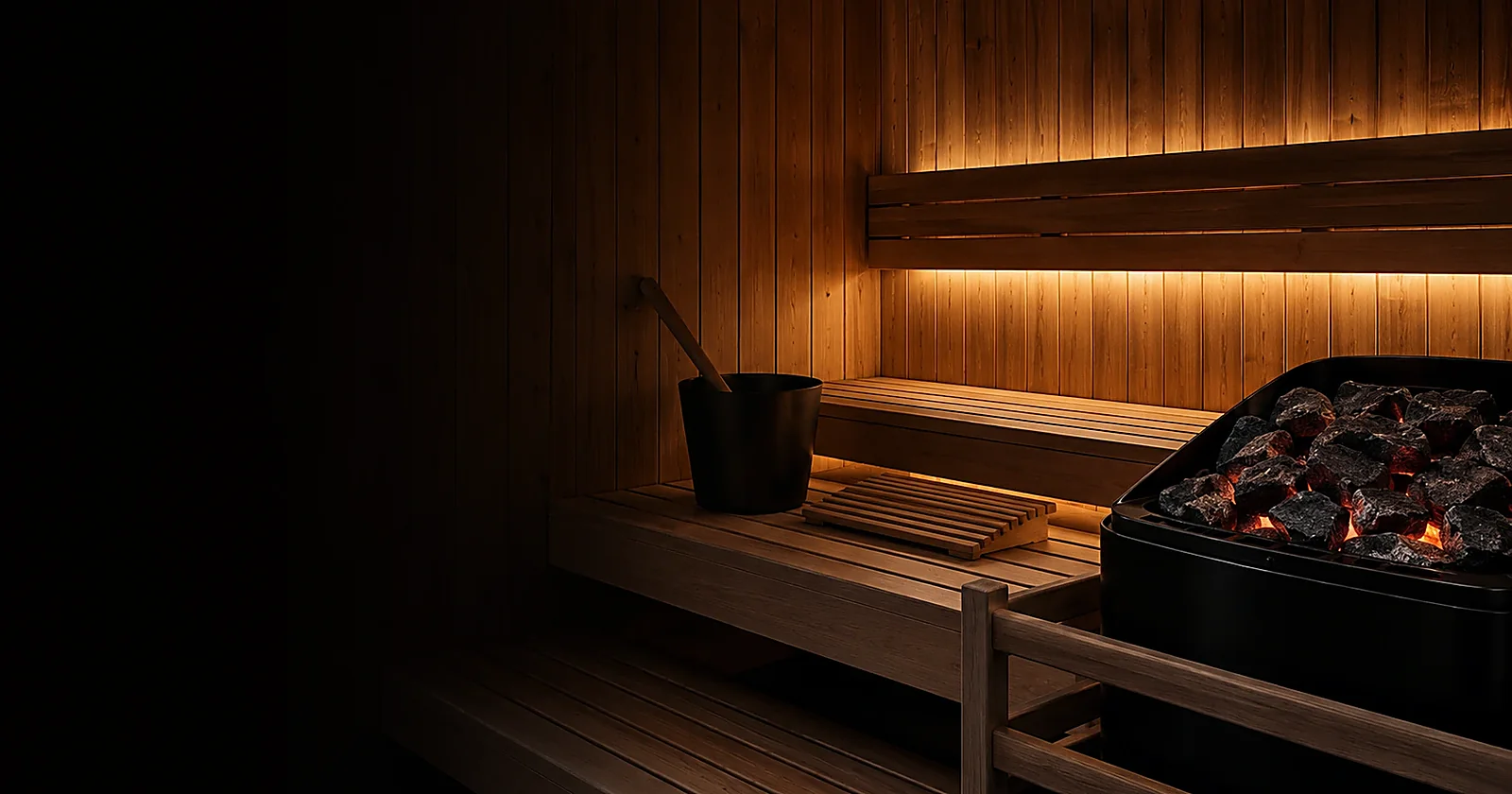
A traditional sauna is the simplest room we build, and the one most often built badly. Dry heat at 80-100 degrees finds every gap in a vapour barrier and exposes every heater that was sized by eye instead of by volume.
80–100°C / 5–15% RH
We build traditional Finnish saunas across Dubai for villas, gyms and hotel spas, from compact two-person cabins to bespoke rooms with full glass fronts. Everything is fabricated to the measured space rather than trimmed to fit on site. As a sauna and steam room contractor in Dubai we carry the joinery and the electrical work in-house, so the heater is specified against the cabin we are actually building.
Walls and ceiling in kiln-dried Nordic spruce or thermowood; benches in aspen or abachi, which stay touchable at 90 degrees. Nothing is varnished, sealed or painted anywhere inside the cabin, because a coating traps moisture in the timber and blisters. The only treatment that belongs in a sauna is paraffin oil on the bench tops.
This is the part nobody sees and the part that decides whether the cabin lasts. Aluminium foil goes behind the cladding, lapped at least 50 mm at every joint and sealed with foil tape, returning at the ceiling and around every penetration. It is never stapled through the face, because each staple is a hole. Behind it sits mineral wool insulation, and in front of it a ventilated cavity of around 20 mm so the cladding can dry.
Approximately 1 kW per cubic metre, adjusted upward for glass, stone or an uninsulated external wall. Undersizing is the most common fault we inherit: the cabin technically works but takes ninety minutes to reach temperature, so nobody uses it. We check the DEWA load and the spare ways in your distribution board at survey stage.
Air enters low, near or beneath the heater, and leaves high on the opposite wall. Without that circuit the cabin stratifies, the upper bench cooks and the lower bench stays cold. A mechanical extract on a run-on timer dries the cabin after use, which matters more in Dubai than in Helsinki because the room outside is air-conditioned and the humidity differential is severe.
| Element | What we specify |
|---|---|
| Operating climate | 80-100°C, 5-15% relative humidity |
| Wall and ceiling | Nordic spruce or thermowood, tongue and groove, unsealed |
| Benches | Aspen or abachi, 500-600 mm deep, radiused edges |
| Vapour barrier | Aluminium foil, 50 mm laps, fully taped, 20 mm ventilated cavity |
| Insulation | 50-100 mm mineral wool |
| Heater | Harvia, Tylö, Sawo, EOS or Helo — 4.5 to 9 kW |
| Supply | Single phase to 4.5 kW; three phase above |
| Door | 8 mm toughened glass, outward opening, no latch |
| Lighting | Heat-rated, shielded, or fibre optic |
| Heat-up time | 30-45 minutes from cold |
| Scope | Indicative installed price | Programme |
|---|---|---|
| Prefabricated cabin, 2-3 person | AED 22,000 - 45,000 | 2-3 weeks |
| Bespoke cabin, 4-6 person | AED 45,000 - 90,000 | 3-5 weeks |
| Bespoke with full glass front | From AED 70,000 | 4-6 weeks |
| Commercial cabin, continuous duty | From AED 60,000 | 4-8 weeks |
A prefabricated cabin is a sealed box that arrives in panels and is assembled in a day or two. It is cheaper, faster, and entirely sensible if your space is a plain rectangle. A bespoke cabin is built to the room: it can follow an awkward corner, take a sloped ceiling, or use the full glass wall that makes a basement sauna feel like something other than a cupboard. Where the space is regular, we will tell you honestly that prefabricated is the better value.
If the room is already a wet area with a drain, a steam room uses what is there. If you are in an apartment where the supply cannot be upgraded, an infrared cabin runs from a normal socket. For a garden or roof terrace, see outdoor and barrel saunas. Our guide on infrared versus traditional saunas compares them properly.
Finnish saunas throughout Dubai — Palm Jumeirah, Emirates Hills, Dubai Hills Estate, Jumeirah Golf Estates, Arabian Ranches and Al Barari — and across Abu Dhabi, Sharjah, Ajman and Ras Al Khaimah. For villa projects specifically, see home and villa sauna installation.
Between 80 and 100 degrees Celsius at the upper bench, with humidity around 5 to 15 per cent. Pouring water on the stones produces loyly, a brief humidity spike that feels considerably hotter without changing the air temperature much. The bench height matters more than the thermostat: there can be 20 degrees difference between the lower and upper bench in the same cabin.
Nordic spruce is the standard for walls and ceilings, thermowood where you want dimensional stability and a darker tone, and western red cedar where budget allows. Benches should be aspen or abachi because both stay cool to the touch and have no resin pockets. Avoid pine with visible knots on bench tops. It looks fine on day one and weeps resin at 90 degrees.
Thirty to forty-five minutes from cold for an electric heater sized correctly to the cabin. If yours takes over an hour, the heater is undersized, the stones have degraded, or the cabin is losing heat through an insulation gap. All three are diagnosable in a single visit.
Roughly one kilowatt of heater per cubic metre of cabin. A 4.5 kW heater covers around 6 cubic metres and runs on a single-phase 25A circuit. Anything from 6 kW upward generally needs three-phase supply. We open the distribution board during the survey and check the spare capacity before quoting, because running a new three-phase circuit is a real cost and it belongs in the quote, not in a variation later.
No. A dry sauna needs no water feed and no drain, which is why it is far easier to fit into an existing room than a steam room. A floor drain is worth having in a commercial installation for washing down, but it is optional in a home.
Very little. Wipe the benches, keep the timber unsealed and untreated, and replace the heater stones every eighteen months or so because they fracture and pack down over time, which restricts airflow through the heater. An annual check of the element and the door seal is enough for most homes.
Low-temperature far-infrared cabins on a 13A socket — no plumbing, no three-phase supply, ideal for apartments and clinics.
Read moreGarden and rooftop cabins in thermo-treated pine, UV-sealed and weather-detailed for 50°C summers and coastal salt air.
Read moreBespoke cabins fitted into villa bathrooms, basements and terraces across Palm Jumeirah, Emirates Hills and Dubai Hills.
Read moreGenuine Harvia, Tylö, Sawo, EOS and Helo heaters and control panels — sized to your cabin volume and DEWA load.
Read moreFully tanked, tiled or acrylic steam rooms at 100% humidity — vapour barrier, fall-to-drain and generator sizing done properly.
Read moreQuarterly descaling, element checks and timber care — annual contracts that keep a room out of downtime.
Read moreThirty minutes on site tells us more than an hour on the phone — and it is the only way to give you a price that does not move.