
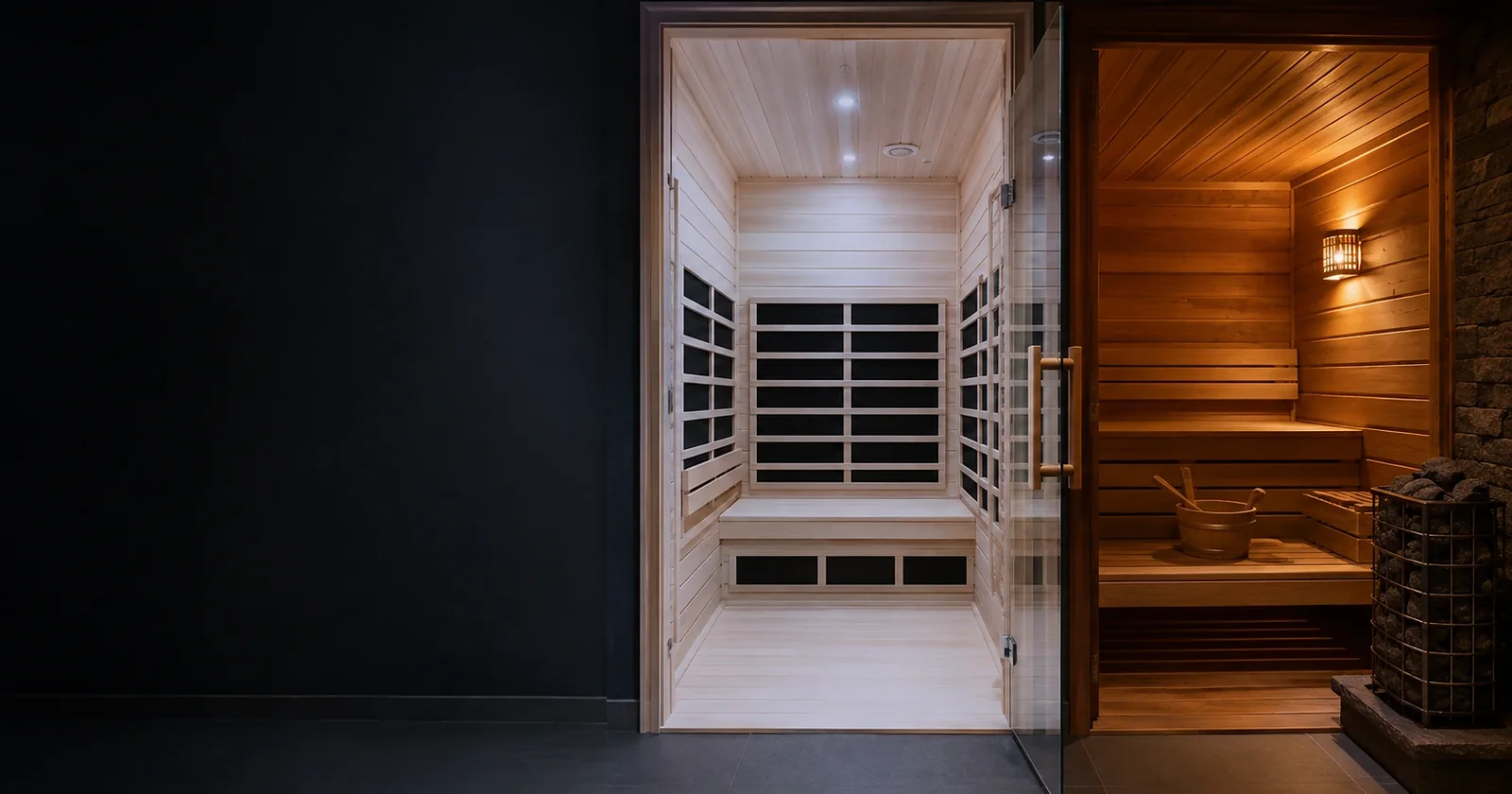
One runs from an ordinary socket. The other may need a new three-phase circuit. In practice that single difference decides more installations than any argument about wellness benefit.
This comparison usually gets argued on wellness grounds, where the evidence is thinner than either side admits. It is more useful to compare them on the things that are not in dispute: what they do to your body's cooling system, what they need from your building, and what they cost.
They work by different mechanisms
A traditional sauna heats the air. The air heats you. At 80 to 100 degrees, your body dumps heat as fast as it can and you sweat heavily within minutes.
An infrared cabin barely heats the air at all. Carbon or ceramic panels emit long-wavelength radiation that is absorbed directly by your skin and the tissue beneath it. The air sits at 45 to 60 degrees, which is why a session can comfortably run forty minutes rather than fifteen.
That is the whole difference, and everything else follows from it.
Side by side
| Traditional Finnish | Infrared | |
|---|---|---|
| Air temperature | 80-100°C | 45-60°C |
| Session length | 10-20 minutes | 30-45 minutes |
| Heat-up | 30-45 minutes | Usable immediately |
| Power draw | 4.5-9 kW | 1.6-2.4 kW |
| Supply needed | Often three phase | Standard 13A socket |
| Installation | Built into the room | Assembled like furniture |
| Can you take it with you? | No | Yes |
| Water on stones | Yes | No |
| Installed cost | AED 22,000 - 90,000 | AED 9,000 - 32,000 |
Why supply decides it in most UAE properties
This is the practical crux. A 6 kW traditional heater generally wants three-phase power. In a villa that may already exist at the board, or it may mean running a new circuit at AED 4,000 to 12,000. In an apartment it usually means asking a building for something they will decline.
An infrared cabin draws about as much as a kettle. It plugs into a dedicated 13A circuit and needs no permission from anyone about load. For anyone in Dubai living in an apartment, that is not a minor advantage — it is the difference between having a cabin and not.
What each is genuinely better at
Traditional wins on: intensity, the ritual of water on stones, the social experience of a proper cabin, resale appeal in a villa, and lower long-term maintenance. It is also the one with the strongest body of long-term health research behind it.
Infrared wins on: installation simplicity, cost, apartment feasibility, portability, comfort for people who find 90 degrees unpleasant, and suitability for clinical and recovery settings where longer supervised sessions are the point.
Our usual recommendation
Villa with space and supply: build the traditional sauna. You will not regret it, and it is the room that makes a house feel finished. Add a cold plunge if you can.
Apartment, or a villa where the board is full: the infrared cabin, without treating it as second best. It is the correct answer to those constraints.
Clinic, physio practice or recovery studio: infrared, for the longer tolerable sessions, the standard power and the surfaces that clean down properly between clients.
Undecided and have the budget: some of our villa clients build both, using infrared on weekdays and the traditional cabin at weekends. That is a luxury rather than a necessity, but it is a real pattern.
What not to base the decision on
Be wary of detoxification claims and specific toxin-elimination figures attached to infrared marketing. Sweat is mostly water and salt. The credible reasons to own either cabin are that heat exposure appears good for cardiovascular health, that it helps people relax and sleep, and that it feels excellent. Those are enough. The rest is sales copy.
Common questions
Is an infrared sauna a real sauna?
It depends on your definition. It produces a sustained sweat response at a lower air temperature, which is what most users are after. It does not produce the intense dry heat, the loyly from water on hot stones, or the ritual that people who love traditional saunas love. Calling it a lesser sauna is unfair; calling it the same thing is inaccurate.
Which one makes you sweat more?
Traditional, generally, and faster. At 90 degrees the sweat response is immediate and heavy. Infrared produces a slower, more sustained sweat over a longer session. Total fluid loss over a full session can end up comparable; the experience getting there is quite different.
Are infrared saunas safe?
Yes, when the panels are from a reputable manufacturer with published low-EMF test figures. Cheap panels are where the concerns come from. Ask for the test data for the specific panel model rather than a general claim in the brochure, and be sceptical if it cannot be produced.
Can you convert a traditional sauna to infrared?
Technically panels can be fitted into an existing cabin, but it is rarely worth doing. A traditional cabin is insulated and sealed for 90 degree operation, which is overbuilt for infrared, and the geometry of bench and panel placement matters more than it does with a heater. Usually the better answer is keeping the sauna and adding an infrared cabin elsewhere if you want both.
Which is better for muscle recovery after training?
Both are used for it, and the honest position is that the evidence does not clearly separate them. Infrared suits recovery use practically, because a 45 minute session at 55 degrees is easier to tolerate straight after training than 15 minutes at 95. That is why recovery studios and physiotherapy clinics tend to fit infrared.