
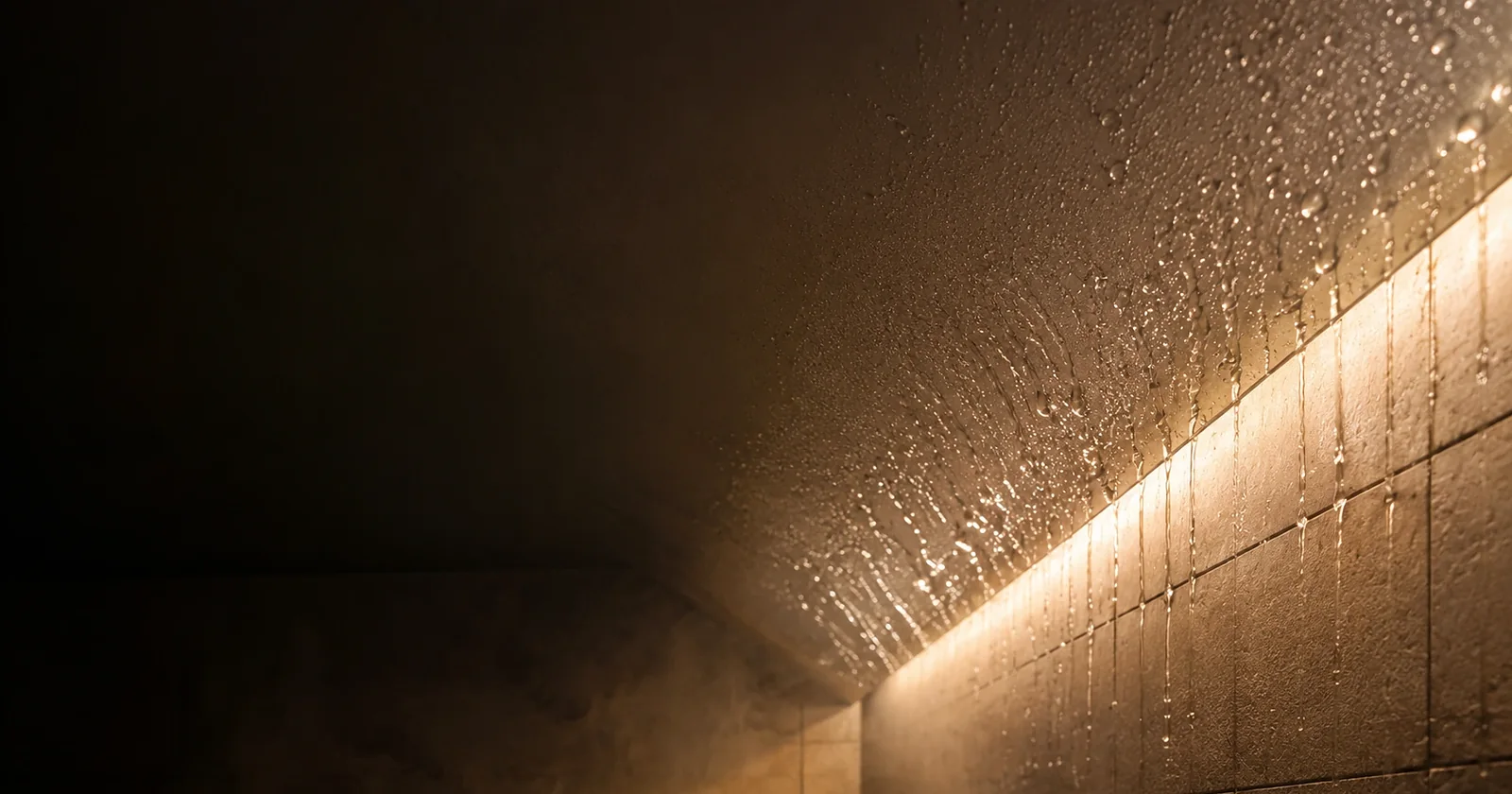
Condensation in a steam room is physics, not a fault. The design question is where it goes. A flat ceiling gives it nowhere to run, so it falls on whoever is underneath.
This is the most common complaint we are called out to, and almost every time the diagnosis takes about four seconds: the ceiling is flat.
What is actually happening
A steam room runs at roughly 45 degrees and 100 per cent relative humidity. Every surface is colder than the vapour, so vapour condenses back to water on all of them. That is not a malfunction. It is the room working exactly as intended.
On the walls, condensation runs down and reaches the drain. On the ceiling, it has to go somewhere too. If the ceiling is level, droplets grow until gravity wins and they fall straight down, onto whoever is sitting beneath. If the ceiling slopes, the same droplets migrate along the underside to the low edge, meet a wall, and run down it. The water is identical; only the geometry differs.
The two-degree rule
A steam room ceiling needs a fall of at least two degrees — around 35 mm per metre — running away from the seating. In a rectangular room this normally means a ceiling that drops from a high side above the bench to a low side above the entry or an unoccupied wall.
More fall is better if headroom allows. What matters is that no part of the ceiling is level, including small returns and the strip above a door frame, because a flat section of any size will collect and drip.
What people wrongly blame
The generator. It is doing its job. If anything, a room that drips heavily is a room the generator is filling successfully.
Ventilation. Extraction is for clearing the room afterwards. During a session you cannot ventilate away saturation without defeating the purpose.
The tiles. Surface finish makes a marginal difference to how droplets form. It does not change where they go.
Fixing an existing room
Honestly, this is the awkward part: correcting a flat ceiling means taking it down. A sloped substrate is built, tanked and tied into the existing wall membrane, then finished. Around one to two weeks and AED 8,000 to 20,000 depending on size and finish.
Where the room is being opened up anyway, it is worth checking the ceiling tanking while access exists. A builder who laid a ceiling flat has often treated the waterproofing above it with similar optimism.
Getting it right the first time
When you review a quote for a new steam room or a steam shower conversion, ask one question: what fall is the ceiling built to? A specialist will answer in degrees or millimetres per metre without hesitating. If the answer is vague, or the concept seems unfamiliar, that tells you what you need to know before any money changes hands.
Common questions
Is a dripping ceiling dangerous?
Not dangerous, but at 45 degrees the drips are hot enough to be genuinely unpleasant, and it puts people off using a room they paid a lot for. The greater concern is what it indicates: if the ceiling was built flat, the tanking above it may have been treated as equally optional.
Can a dripping ceiling be fixed without a full rebuild?
The room itself does not need rebuilding, but the ceiling does. A sloped substrate is formed, tanked into the existing wall membrane, and re-finished. Typically one to two weeks and AED 8,000 to 20,000 depending on size and finish. Nobody enjoys hearing that, which is why it is worth insisting on the fall at build stage.
What fall does a steam room ceiling need?
A minimum of two degrees, which is about 35 mm of drop per metre. More is better where headroom allows. The fall should run away from where people sit, so condensation tracks down a wall rather than over the bench.
Would a fan or extractor stop the dripping?
No. Extraction clears the room after a session, which is useful, but during use the room is deliberately saturated. You cannot ventilate away 100 per cent humidity while a generator is actively producing steam. The answer is geometry, not airflow.
Do domed hammam ceilings work for the same reason?
Exactly the same reason. The traditional dome in a Turkish hammam carries condensation down the curve to the perimeter rather than dropping it on the bather. It is a functional solution that happens to look beautiful, arrived at centuries before anyone wrote it into a standard.