
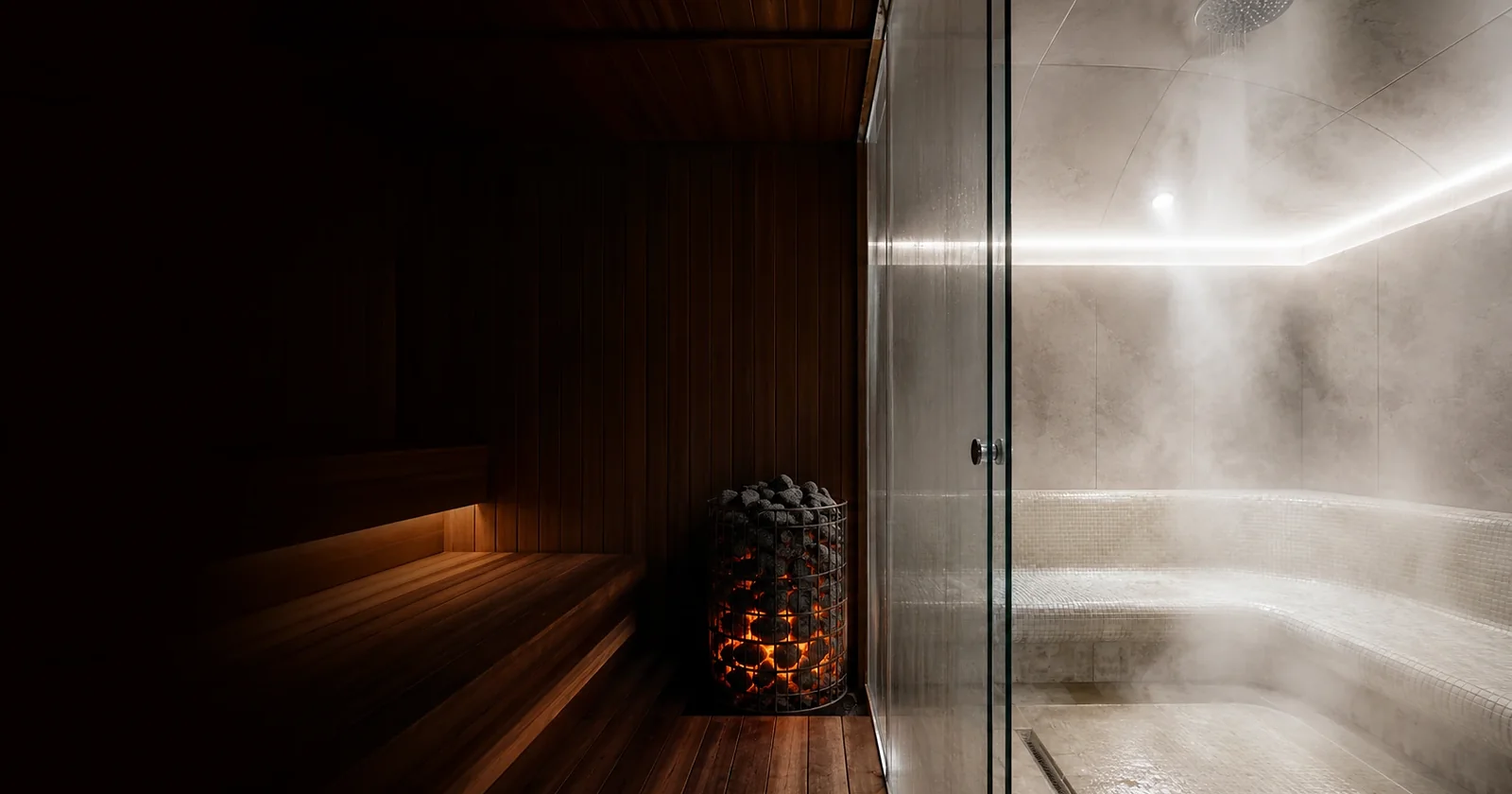
The wellness arguments come down to preference. These are the practical differences that decide what your space can actually take, and what it will cost you to run.
We get asked this at almost every villa survey, and the answer is rarely about which feels nicer. It is about what your room can physically accommodate, what your distribution board can carry, and how much maintenance you are realistically going to do. Here is how the two compare on the things that actually decide it.
The basic difference
A Finnish sauna is dry heat: 80 to 100 degrees at around 5 to 15 per cent humidity, produced by an electric heater with stones on top. Pouring water on the stones creates a brief humidity spike — loyly — that feels far hotter without much changing the air temperature.
A steam room is the opposite: 43 to 46 degrees at 100 per cent humidity, produced by a generator boiling water and piping vapour into a sealed, fully waterproofed room. It feels hot because you cannot evaporate sweat, not because the air is hot.
Side by side
| Finnish sauna | Steam room | |
|---|---|---|
| Climate | 80-100°C, 5-15% humidity | 43-46°C, 100% humidity |
| Build | Insulated timber cabin, foil vapour barrier | Fully tanked, tiled, sloped ceiling |
| Plumbing | None | Water feed and floor drain |
| Electrical | 4.5-9 kW heater, often three phase | 6-15 kW generator plus supply |
| Heat-up | 30-45 minutes | 10-15 minutes |
| Build cost, 2-3 person | AED 22,000 - 45,000 | AED 25,000 - 55,000 |
| Maintenance | Low — stones, seals, annual check | Higher — descaling every 3-6 months |
| Retrofit difficulty | Easy into a dry room | Easy only into an existing wet room |
What actually decides it: your room
Forget the comparison for a moment and look at the space.
If it is a dry room — a basement corner, a store, the end of a dressing room — a sauna is straightforward. Insulate, line, seal the vapour barrier, run a circuit, done. Putting a steam room there means introducing drainage and waterproofing where none exists, which is a different and much larger job.
If it is already a wet room with a drain and tiling, the calculus flips. The drainage and the water feed are the expensive parts of a steam room and you already have them. See steam shower installation for the least disruptive version of this.
If your ceiling is high, lean toward a sauna. Steam room ceilings should stay under about 2.4 metres, because you are heating volume nobody sits in and the generator has to work harder for it permanently. A sauna cabin simply gets built with its own ceiling at the right height, ignoring the room above.
The electrical question people discover too late
Both need proper supply and this is where quotes move. A sauna heater runs roughly 1 kW per cubic metre: a 4.5 kW unit on single phase covers a small cabin, but from 6 kW upward you generally need three phase. Steam generators sit between 6 and 15 kW with the same implications.
Some Dubai villas have spare three-phase capacity sitting at the board. Others need a circuit run across the house, which is AED 4,000 to 12,000 of genuine work. Check this before you fall in love with a design — details on our Dubai page and in heater sizing.
What we build, and for whom
Villa basements and utility rooms: almost always a Finnish sauna, frequently with a glass front so the room does not feel like a cupboard.
Existing large bathrooms: usually a steam room or a steam shower conversion, because the wet infrastructure is there.
Apartments: an infrared cabin, because it runs from a normal socket and needs no plumbing at all.
Anyone with the space for both: both, plus something cold between them. That is the arrangement people use most and abandon least.
So which should you choose?
If your space is dry and you want low maintenance, build the sauna. If your space is an existing wet room and you want gentler heat and faster warm-up, build the steam room. If you are in an apartment, build the infrared cabin. And if none of that resolves it, a thirty-minute survey will, because the constraint is almost always sitting in the room rather than in the decision.
Common questions
Which is healthier, a sauna or a steam room?
The research on cardiovascular benefit is strongest for traditional Finnish sauna use, largely because that is where the long-term population studies have been done. That does not mean steam rooms lack benefit; it means they have been studied less. For most people the honest answer is that the one you will actually use several times a week beats the one you use twice and abandon.
Which is cheaper to build?
A sauna, usually by a clear margin. A dry cabin needs no waterproofing, no drainage and no generator. A steam room needs the room tanked to full height, a graded ceiling, a floor falling to a drain and a generator sized to volume. Same footprint, roughly double the build cost.
Which is cheaper to run?
A steam room, slightly, because it operates at 45 degrees rather than 90 and heats in ten minutes rather than forty. But the difference is small enough that it should not decide anything. Maintenance is the real running cost, and there the sauna wins comfortably.
Can you have both?
Yes, and in villas with the space it is the arrangement we build most often, usually with a cold shower or plunge between them. Building both at once shares the drainage, the electrical route and the tiling, which costs considerably less than adding the second one two years later.
Which is better for a Dubai apartment?
Neither in their traditional form, usually. An infrared cabin runs from a standard socket with no plumbing, which is why it dominates apartment installations. Where there is an existing sealed shower enclosure, a steam shower conversion is the other realistic option.