
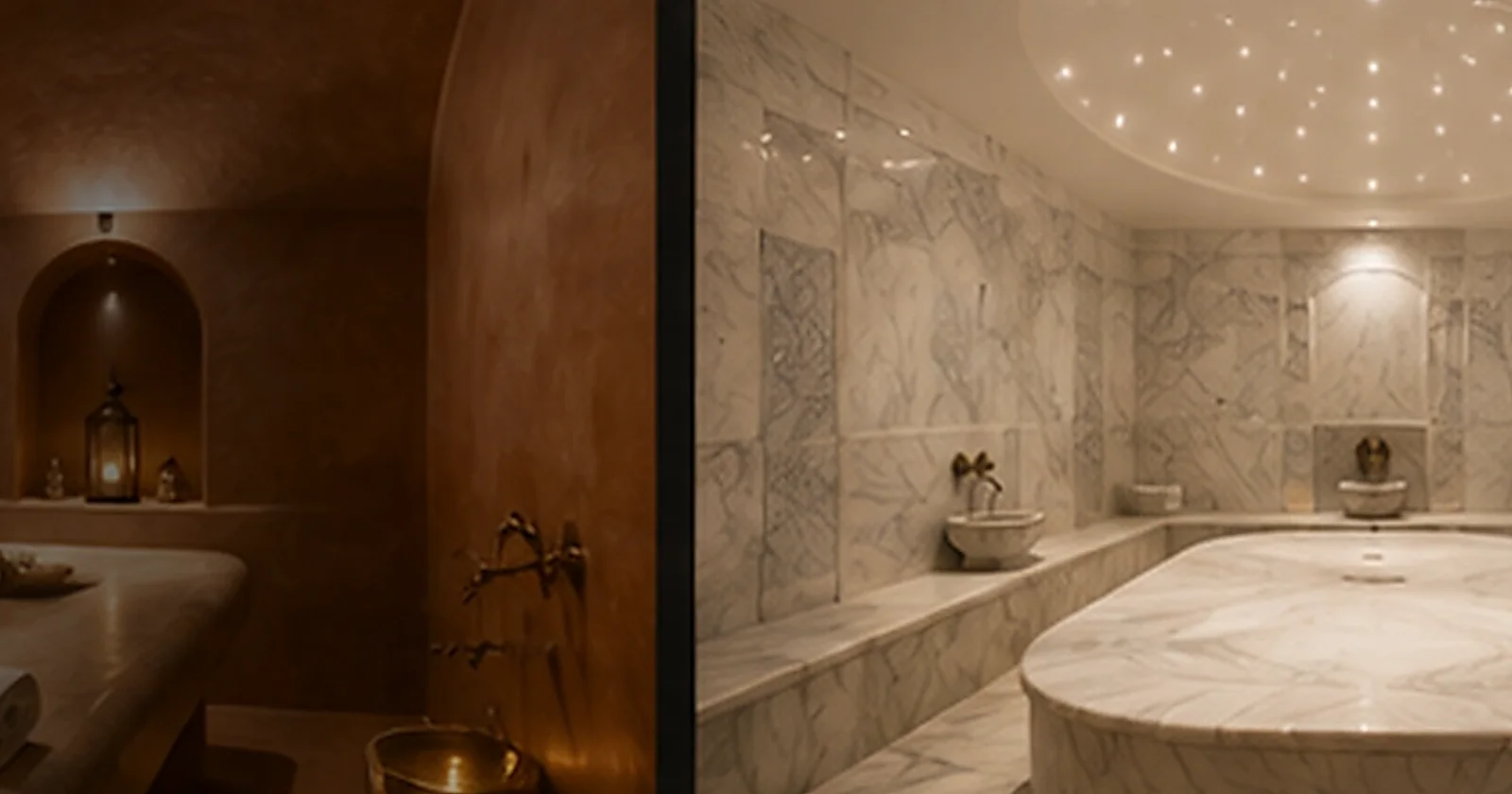
They are used interchangeably in conversation and they are not interchangeable in construction. One is a treatment room; the other is an architectural room built around a heated stone slab.
Clients frequently ask for one and describe the other. Since the two differ by a factor of three in cost, it is worth being precise before anyone quotes.
The Turkish hammam
A hammam is architecture. The room is built around a göbektaşı — a large heated marble platform at its centre, warmed from below by heating circuits laid in a screed beneath the stone. Bathers lie directly on the warm stone, often for an hour, and the washing and scrubbing happens there.
Around it sit carved stone basins fed with tempered water, heated perimeter benches, and traditionally a domed ceiling pierced with small openings. The dome is not decorative: its curve carries condensation to the perimeter instead of dropping it on the people below.
Air temperature is 40 to 45 degrees, cooler than a steam room, with the sensation coming largely from radiant heat through the stone.
The Moroccan bath
A Moroccan bath is a treatment. Steam opens the pores, black soap is applied and left, then a therapist exfoliates with a kessa glove, usually on a heated bed. It typically runs forty-five minutes to an hour.
The room is smaller and simpler: tadelakt or microcement walls, a heated treatment bed at a working height, a hand shower, generous drainage and a steam supply. There is no central slab and no structural stonework, which is why it costs a fraction of a hammam to build.
Side by side
| Turkish hammam | Moroccan bath | |
|---|---|---|
| Centrepiece | Heated marble slab | Heated treatment bed |
| Position | Lying on stone | Lying on a bed, therapist-led |
| Climate | 40-45°C, 80-100% RH | 40-45°C, 90-100% RH |
| Ceiling | Domed or vaulted | Flat, tanked, graded |
| Room size | 3 × 3 m minimum | 2.5 × 2 m workable |
| Structural check | Often required | Rarely |
| Build cost | AED 60,000 - 280,000 | AED 35,000 - 120,000 |
| Programme | 4-10 weeks | 4-8 weeks |
Which should you build?
Salon or day spa: a Moroccan bath room. Smaller, quicker, and matched to what your clients are booking.
Hotel spa or large villa: a Turkish hammam, if the floor loading and the space allow. It is a genuine centrepiece and nothing else feels like it.
Wanting wet heat without either: a steam room costs a fraction of both and delivers the humidity, without the stone or the treatment function.
For multi-room projects combining several of these, see commercial spa fit-out.
Common questions
Which is more authentic?
Both are authentic to their own traditions. The Moroccan hammam and the Turkish hamam evolved separately from a shared Roman-Byzantine root, and the differences reflect local custom rather than one being a version of the other. In the UAE the terms have blurred commercially, with 'Moroccan bath' generally advertised as a treatment and 'hammam' generally describing a room.
Which costs more to build?
A Turkish hammam, considerably. A private hammam starts around AED 60,000 and a full one with a marble slab and dome runs from AED 120,000 upward, because of the stone, the underfloor heating within the slab and often a structural loading assessment. A Moroccan bath treatment room typically lands between AED 35,000 and 120,000 depending on finish and whether it is domestic or commercial.
Which is better for a salon?
A Moroccan bath room, almost always. It is smaller, less structural, faster to build and matches the treatment most UAE salon clients are actually booking. A hammam is an architectural centrepiece and belongs in a hotel spa or a large villa rather than a treatment suite.
Can you have a hammam in a villa?
Yes, and we build them. The practical requirements are floor loading capable of carrying the slab and screed, a drain, a route for steam supply, and realistically about 3 by 3 metres of floor area so that the slab is large enough to lie on properly.
What is tadelakt?
A polished lime plaster traditionally sealed with olive oil soap, producing a seamless waterproof surface with no grout lines. It is characteristic of Moroccan interiors, it works well in this climate, and it needs periodic re-sealing. Microcement over a tanking membrane is the lower-maintenance modern alternative.