
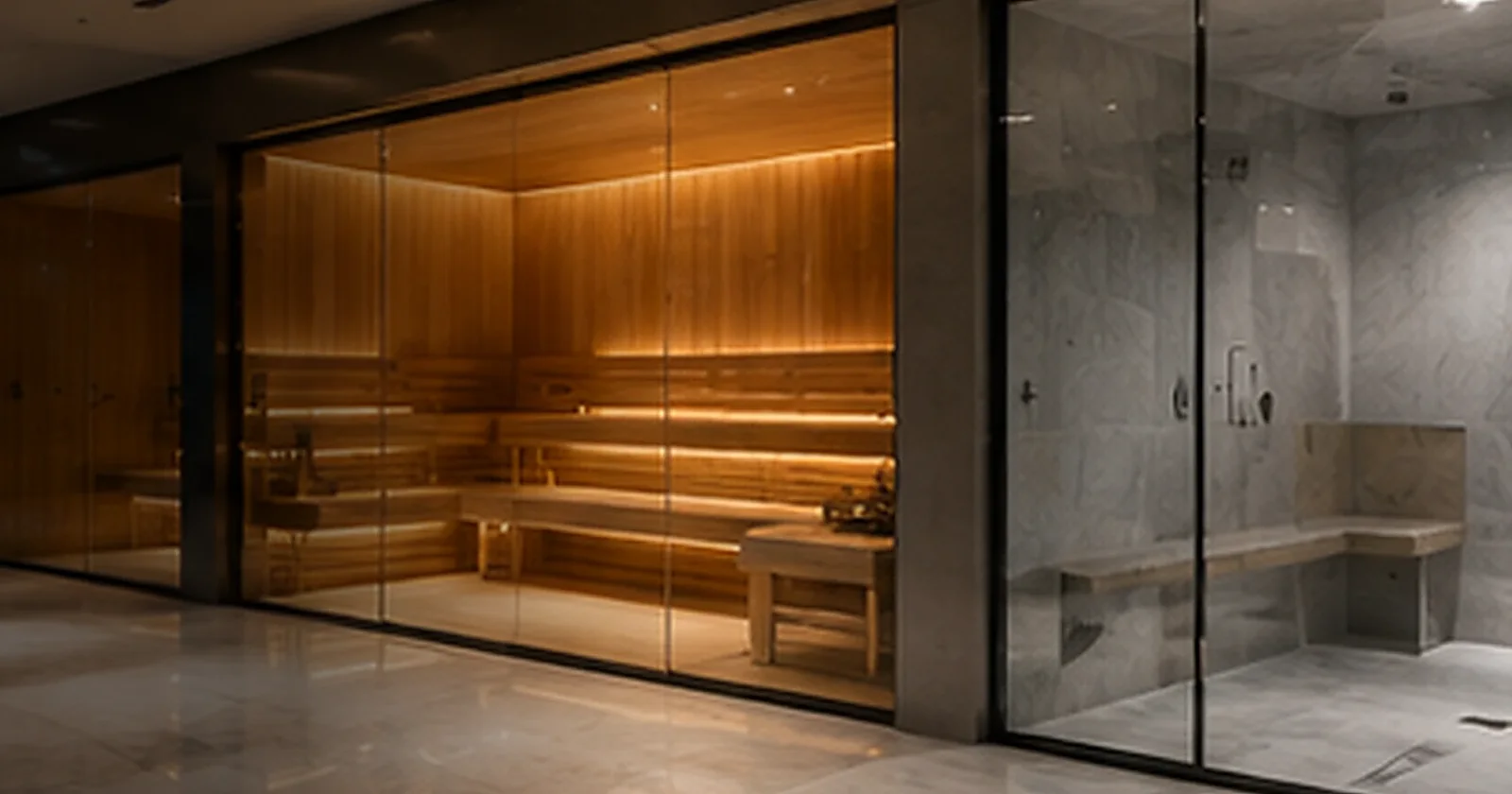
A commercial thermal room is judged on one number that never appears in a build quote: how many hours a year it is actually open.
We are asked to price gym and club thermal rooms regularly, and we are asked to repair them even more often. The failures are consistent enough to be worth listing.
1. Domestic equipment in a commercial room
This is the big one. A heater rated for domestic use assumes an hour a day. Put it in a gym running from 6am to 11pm and the element life collapses — often inside a year.
Commercial units cost 30 to 50 per cent more up front. They cost dramatically less over five years, and they do not close your sauna during peak membership renewal season. When comparing tenders, ask for the model number of every heater and generator, then check what duty it is rated for.
2. Plant nobody can reach
Steam generators need descaling every one to three months in this water. If the unit is sealed behind a tiled wall, every service becomes a demolition job, which in practice means it never gets serviced at all.
Plant should be positioned so an engineer can attend without entering the guest area and without closing the facility. Access hatches designed in at the start, not cut in later.
3. Ventilation designed for the room, not the traffic
A domestic steam room is used once or twice an evening. A gym room might see forty people across a day, each opening the door. Extraction has to clear the room between users and manage humidity migrating into changing areas, or you will be replacing ceilings and lockers within three years.
4. Benches and hardware specified domestically
Bench timber in a commercial cabin takes constant traffic and constant cleaning. Door hinges take thousands of cycles a month. Both need specifying for that, and neither is expensive to get right at build stage.
5. No maintenance contract
The most avoidable of all. Without scheduled attendance the first indication of a problem is a closed door and a complaint at reception. With a contract — quarterly or monthly, plus a small spares holding — most failures are prevented and the rest are fixed in a day rather than a fortnight. See maintenance and AMC.
What good looks like
| Element | Commercial standard |
|---|---|
| Heater / generator | Duty-rated for continuous operation |
| Plant access | Serviceable without closing the facility |
| Ventilation | Sized for bather turnover, not room volume alone |
| Benching | High-traffic timber, replaceable slats |
| Drainage | Sized for wash-down, falls across full floor |
| Controls | Lockable, staff-operated, with weekly timers |
| Handover | O&M pack, staff training, spares list |
| Aftercare | Contract with priority response |
Phasing around a trading facility
Most gyms cannot close. Our commercial programmes are built around your quiet periods with agreed working hours, containment and protected access routes. It extends the programme and it is invariably cheaper than lost membership. Full scope at commercial spa fit-out, with the individual rooms covered under sauna and steam room installation.
Common questions
What makes equipment commercial rather than domestic?
Duty rating. A domestic heater or generator is designed for perhaps an hour of operation a day. Commercial units have heavier elements, better thermal management and serviceable components, because they are built to run sixteen hours. Fitting a domestic unit in a gym is the single most common and most expensive error we see, and it usually surfaces within the first year.
How much more does commercial specification cost?
Typically 30 to 50 per cent more on equipment. Over five years it costs considerably less, because you are not replacing elements annually and not closing rooms while you wait for parts. The comparison that matters is five-year cost including downtime, not the tender price.
Can the facility stay open during the work?
Usually yes, with phasing. Most of our gym and hotel projects run while the facility trades, with agreed working hours, dust and noise containment and protected routes through public areas. It takes longer overall and costs more than a closed-site programme, and it is almost always cheaper than closing.
How often do commercial rooms need servicing?
Monthly to quarterly depending on hours of use. Steam generators in commercial use need descaling every one to three months in UAE water. Sauna heaters need element and stone checks far more often than domestic ones. Without a contract, the first sign of a problem is usually a closed room.
What documentation should we get at handover?
Wiring diagrams, equipment schedules with model numbers, commissioning records, cleaning and chemical regimes, a maintenance schedule and a recommended spares list. Facilities most often fail because nobody told the engineering team what the room needed, rather than because the equipment was poor.