
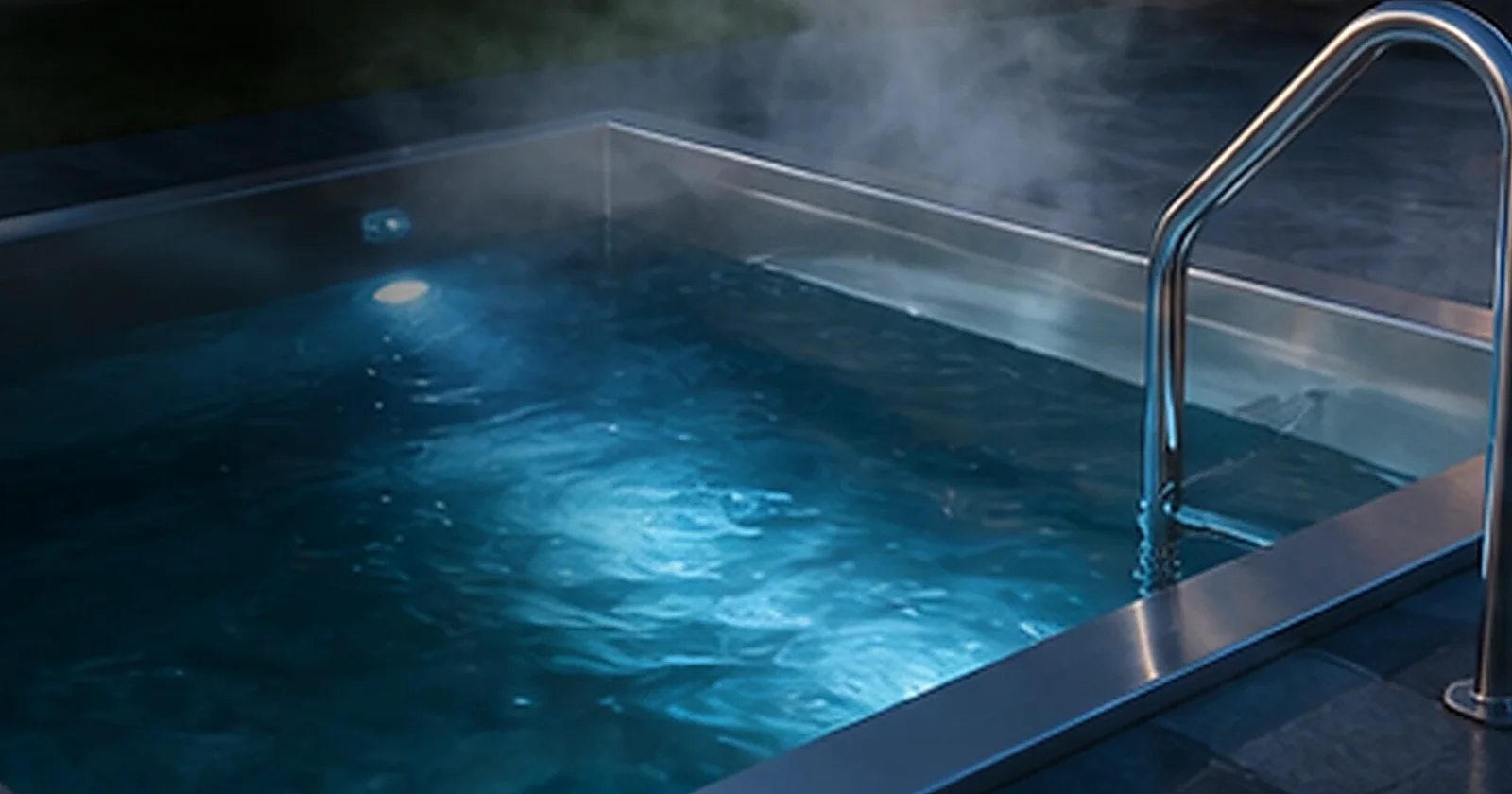
Anyone can put cold water in a tank. Holding it at 5 degrees through August, without the chiller running permanently, is an engineering problem — and it is the one most installations here get wrong.
Cold plunges have gone from niche to expected in villa wellness rooms in about three years. The physics of running one in this climate has not changed at all, and it is not what most suppliers specify for.
Why imported specifications fail here
Chiller capacity is always quoted against an assumed ambient temperature. A unit rated to hold a given volume at 5 degrees is rated against something like a 25 to 30 degree environment.
Dubai in August is 45 degrees in the shade and considerably hotter beside a sun-facing wall. The same chiller now has to remove far more heat continuously to hold the same setpoint. It runs without cycling, never quite reaches target, and shortens its own life doing it.
The fix is not exotic — specify against local ambient with headroom. It usually means a larger unit than the catalogue suggests, and it pays for itself in reliability alone.
Insulation matters more than chiller size
This is the part that gets skipped, and it is more important than the compressor.
An uninsulated tank sitting in hot air is a heat exchanger working against you every hour of the day. Closed-cell insulation to the tank body and base, insulated pipework, and above all an insulated lid.
The lid alone makes a startling difference, because the water surface is where most heat gain occurs. A plunge left open all day in a Dubai summer will cost several times what the same plunge costs with a cover on it between uses.
Specification we work to
| Element | Specification |
|---|---|
| Operating temperature | 4-15°C, adjustable |
| Chiller sizing | Against 45-48°C ambient, with headroom |
| Tank insulation | Closed-cell to body and base |
| Pipework | Short runs, fully insulated, shaded |
| Cover | Insulated, used between sessions |
| Filtration | Turnover matched to bather load |
| Sanitisation | Ozone or UV, low residual |
| Electrical | RCD-protected dedicated circuit, IP-rated isolation |
| Entry | Non-slip step and grab rail — not optional at 5°C |
Cost
| Scope | Installed price |
|---|---|
| Self-contained plunge, 1-2 person | AED 18,000 - 35,000 |
| Built-in plunge, remote chiller | AED 35,000 - 60,000 |
| Commercial recovery plunge | From AED 55,000 |
| Chiller retrofit to existing plunge | AED 12,000 - 28,000 |
Build it next to something hot
The single best predictor of whether a plunge gets used is whether there is heat beside it. A plunge on its own is a test of willpower two or three times before it becomes garden furniture. A plunge next to a sauna is part of a cycle people repeat for years.
Installing both together also shares the groundwork, drainage and electrical route, which costs materially less than adding the second one later. Full detail on cold plunge pool installation, and for outdoor pairings see outdoor and barrel saunas.
Common questions
Can a cold plunge really hold 5 degrees in a Dubai summer?
Yes, with a chiller sized against local ambient and a properly insulated tank. Both parts are necessary. A correctly sized chiller on an uninsulated tank will run continuously and still struggle; a well-insulated tank with an undersized chiller will drift upward through the afternoon.
What does a cold plunge cost to run?
Far less than people assume, provided it is insulated and covered. A chiller only works when heat gets in, so closed-cell insulation on the tank, insulated pipework and an insulated lid do most of the work. Well specified, a domestic plunge costs a modest amount monthly in summer and very little in winter. Poorly specified, that figure multiplies several times over.
Where should the chiller be positioned?
Shaded, well ventilated and accessible. A chiller rejects heat, so placing it in a sealed cupboard or in full afternoon sun makes it fight its own exhaust. Keep pipe runs short and fully insulated, because every metre of bare pipe in 45-degree air is heat walking into your cold water.
How is the water kept clean?
Filtration plus sanitisation, generally ozone or UV with a low residual. Cold water is less hospitable to bacteria than warm, but a plunge used daily by several people still needs proper turnover. Commercial installations are specified to the expected bather load rather than to volume alone.
Should I get a plunge or a chest freezer conversion?
A converted freezer is cheap and it does work, in the sense that it makes water cold. What it lacks is filtration, sanitisation, proper insulation on the pipework, safe electrical isolation near water, and any way to enter and exit safely. For occasional personal use it is a legitimate hack. For a household, or anywhere near a commercial setting, it is not.